


Industrial Drying with Waste Heat: Assessment and Integration Guide
Waste heat can reduce purchased fuel for an industrial dryer when the source, temperature and operating schedule match the drying duty. A statement such as “flue gas is available” is not enough to size the system. The heat source and the wet material both need an engineering assessment.
Start with the heat-source data
Provide the heat medium and its source, supply and expected return temperatures, flow rate, pressure, composition, allowable pressure drop and hours of availability. Record normal, minimum and maximum conditions. For exhaust gas, include oxygen, moisture, dust, corrosive constituents and any pollutants relevant to product contact or emissions.
Distance between the heat source and dryer matters because ducting or piping adds heat loss and pressure drop. Explain whether the source continues during dryer start-up, turndown and shutdown, and whether a backup heat source is required.
Direct and indirect use are different
Direct use of a gas stream
A suitable gas stream may be conditioned and brought into contact with the material. This can avoid an intermediate heat-transfer step, but contamination, corrosion, dust, odour, emissions, temperature variation and product safety must be evaluated. The source plant and dryer also become operationally linked.
Indirect recovery through a heat exchanger
A heat exchanger can transfer energy from flue gas, hot water, steam condensate or another source to a clean drying-air circuit. Separation can protect the product from the source stream, but the exchanger adds temperature approach, pressure drop, fouling, cleaning and capital cost. The recoverable heat is lower than the gross energy in the source.
Estimate heat availability before promising savings
For a single-phase fluid with reliable properties, the gross sensible heat can be screened using heat flow = mass flow × specific heat × usable temperature change. This is only an initial estimate. The final heat balance must consider source variability, heat-exchanger approach, leakage, losses, fan or pump power, exhaust conditions and the energy needed to heat the feed and evaporate water.
Compare the usable heat with the calculated water-removal duty. Heat at a lower temperature may still be useful, but it can require more air flow, heat-transfer area or residence time. The material’s allowable temperature and drying kinetics remain decisive.
Why belt dryers are often assessed for low-temperature heat
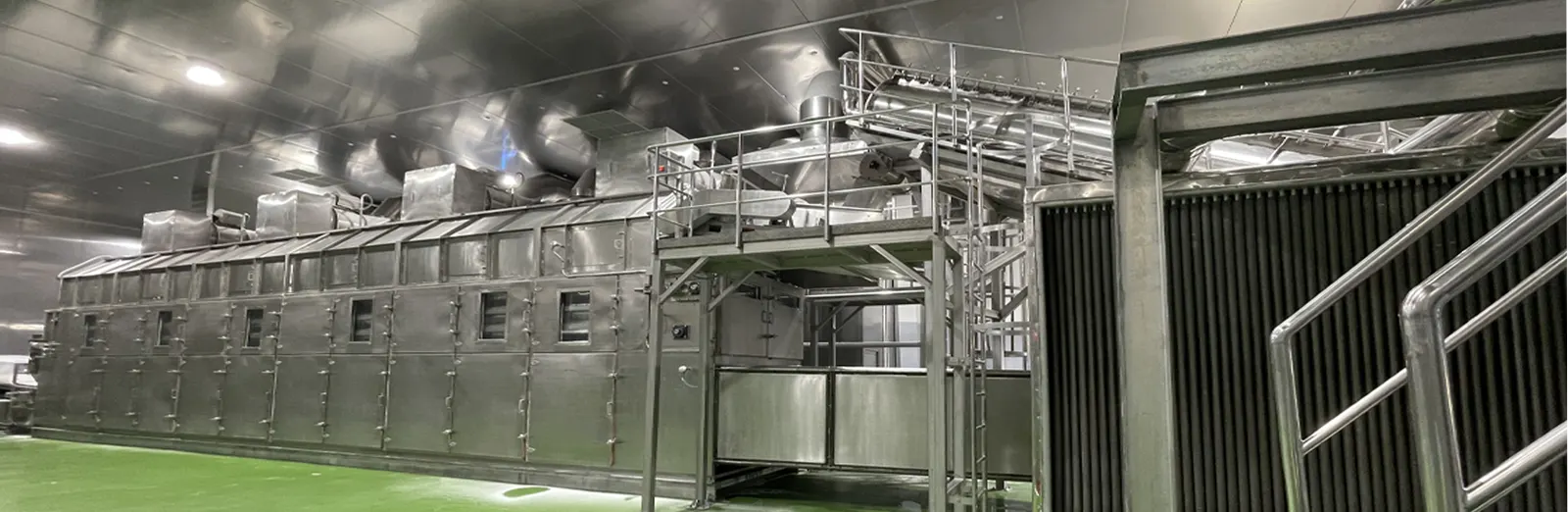
A belt dryer can provide a long residence time and staged airflow for a suitable product bed, which can make it a candidate for available low- or medium-temperature heat. Suitability is not automatic. The system must still deliver enough air at the necessary temperature and humidity, and the feed must remain transportable and permeable during drying.
See the biomass belt-drying guide, sludge and biosolids guide and digestate project guide for application-specific inputs.
Controls and operating cases to define
- Normal, minimum and maximum source temperature and flow.
- Dryer production when the heat source is unavailable.
- Bypass, dilution, recirculation and backup-heating philosophy.
- Protection against high product temperature, fire, condensation and corrosion.
- Fan, damper and feed control during changing process conditions.
- Cleaning and inspection access for ducts, coils or heat exchangers.
Build the business case from measured data
Compare annual recovered energy with the installed cost of heat exchangers, ducting, controls, fans, civil work and backup heating. Include maintenance, fouling, production hours, the value of displaced fuel and any effect on the source process. A saving percentage should only be stated after the heat balance and operating profile are agreed.
GEM’s published gelatin filter-press sludge case study describes one project using existing plant flue gas. Its conditions and results are project-specific. Use the equipment and operating-cost checklist, then send your heat-source and material data for an application assessment.
