


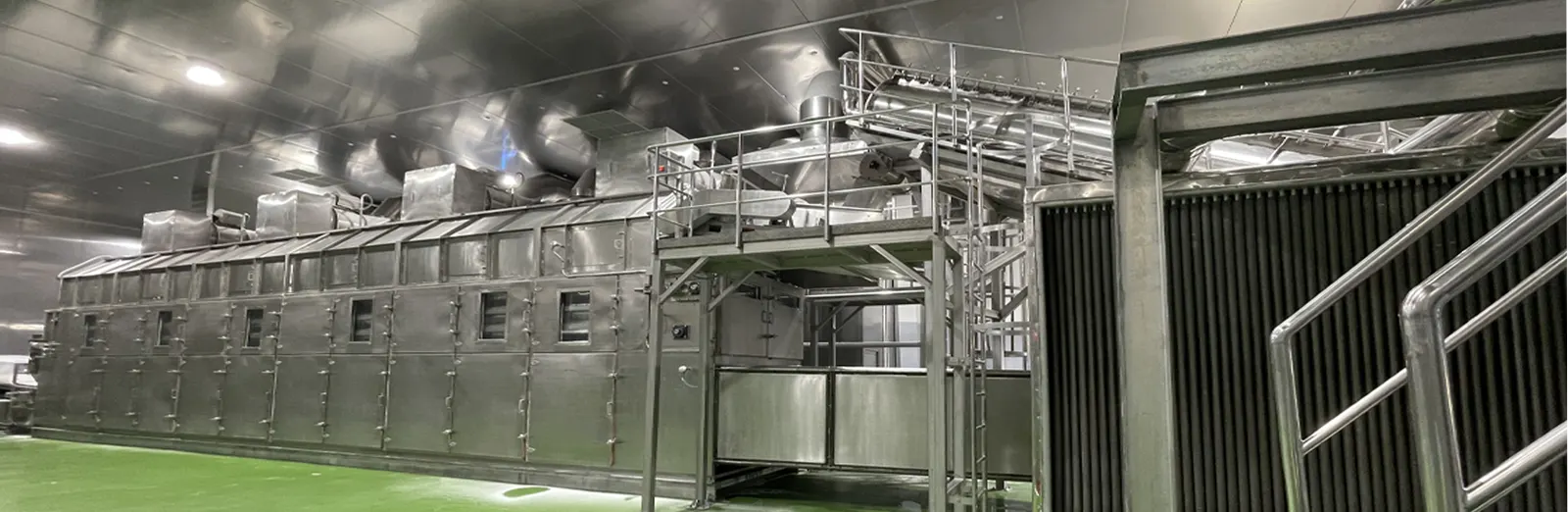
Belt Dryer vs Rotary Dryer: Which Fits Your Material and Process?
Belt dryers and rotary dryers are both used for continuous industrial drying, but they handle and expose material differently. A belt dryer carries a distributed bed through controlled air zones. A rotary dryer moves material through a rotating drum, where internal flights or other features can lift and mix the feed. Selection should follow the actual material and process duty.
Belt dryer vs rotary dryer: quick comparison
| Decision factor | Belt dryer | Rotary dryer |
|---|---|---|
| Material movement | Material rests on a moving belt with limited agitation, except at feed and transfer points | Material advances through a rotating drum and is repeatedly moved or showered, depending on the internal design |
| Feed form | Requires a feed that can be spread and carried as a stable, permeable bed | Can be evaluated for robust granular, fibrous or particulate feeds that tolerate drum movement |
| Product handling | Useful when limiting mechanical action matters, subject to belt transfers and loading | Provides more mixing and particle movement; attrition and dust need assessment |
| Temperature control | Can use multiple zones with separately managed air conditions | Air and material conditions change along the drum; direct and indirect heating arrangements are available |
| Footprint | Single-pass systems can be long; multi-pass systems exchange length for height and product transfers | Requires drum length plus feed, drive, gas-handling and discharge space |
| Wear and cleaning | Assess belt, supports, tracking, air passages and deposits | Assess shell, flights, seals, tyres, rollers and abrasion from the feed |
When a belt dryer may fit
A belt dryer can be evaluated when continuous production, staged air conditions or comparatively gentle transport is important. Suitable material must remain on the selected belt and allow the required airflow. Foods, feeds, biomass and prepared sludge can behave very differently; each needs its own loading, residence-time and cleaning assessment.
For sticky or paste-like feeds, describe the planned dewatering, extrusion, granulation, back-mixing or distribution system. A material name alone does not establish that it will form a usable bed.
When a rotary dryer may fit
A rotary dryer can be evaluated for material that benefits from tumbling and repeated exposure to the drying gas. It is commonly considered for robust bulk solids and prepared biomass. Particle size distribution, fines, abrasion, breakage, deposits and fire or dust hazards need to be assessed.
Direct rotary drying brings the process gas into contact with the material. An indirect rotary design separates the main heating medium from the product through a heat-transfer surface. These are different process arrangements with different temperature, gas-flow, containment and capital implications.
Do not choose on capacity alone
Two dryers offered for the same wet-feed capacity may have different water-removal duties, residence times and scope. Establish the dry-solids balance first. Then compare inlet and outlet moisture on the same basis, product temperature, heat source, exhaust conditions, electrical load, start-up, turndown and ancillary equipment.
Use the water-removal calculation and the industrial belt dryer RFQ checklist to prepare the design basis.
Questions for a supplier comparison
- How is the feed prepared, metered and distributed?
- What drying tests or reference data support the proposed residence time?
- What is the guaranteed duty and its stated operating basis?
- How are dust, odour, emissions, fire risk and contamination addressed?
- Which parts are expected to wear, and how are they inspected and replaced?
- What happens during minimum load, feed interruption and shutdown?
- Which equipment and site works are included or excluded?
Use project evidence appropriately
GEM’s published examples include a continuous band dryer for cranberry pomace and a rotary sawdust drying system. These illustrate different projects; their results should not be transferred to another feed without engineering review.
Compare the band dryer, mesh belt dryer and rotary dryer. Discuss representative material testing through the GEM pilot-trial programme, or send your process data for a preliminary assessment.
