


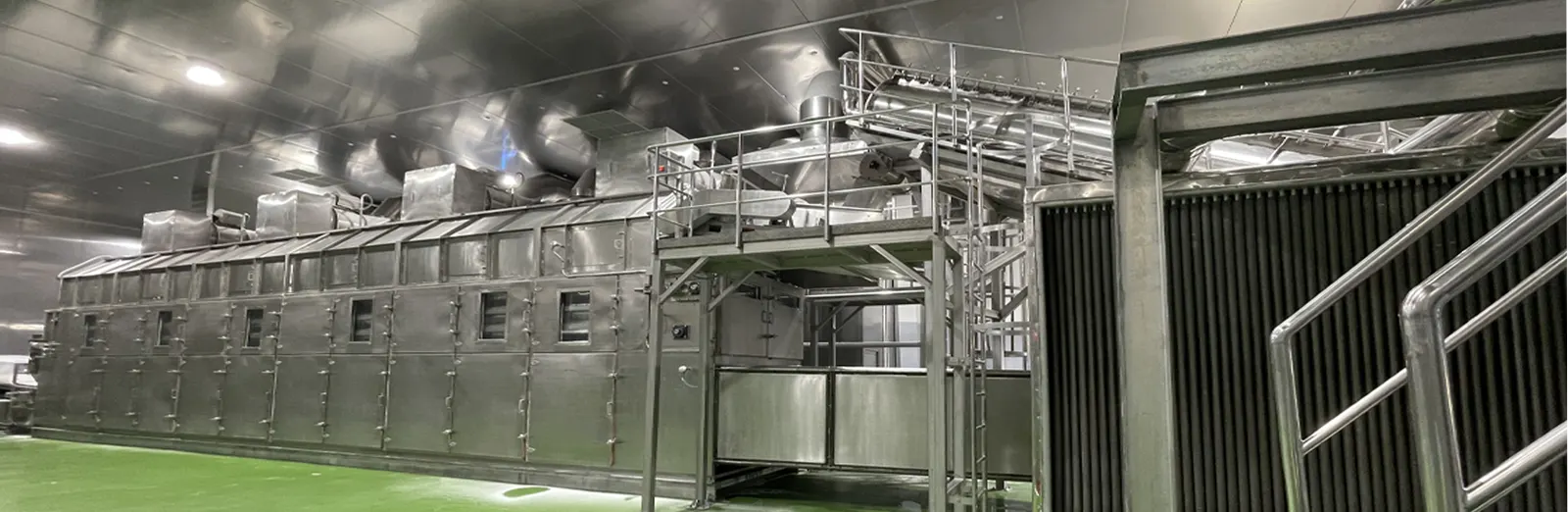
Belt Dryer Cost: Equipment Scope, Utilities and Operating Costs
The price of an industrial belt dryer depends on the drying duty and the scope of supply. Two systems with the same wet-feed capacity can require different drying areas, heat inputs and handling equipment. A useful comparison starts with the material, inlet moisture, target moisture and operating hours.
Define the drying duty before comparing prices
State whether capacity refers to wet feed, dry solids or discharged product. Give both inlet and outlet moisture on the same basis. Include material composition, particle size, bulk density, temperature sensitivity and expected variation in the feed. Representative trials may be needed before equipment selection.
For example, an enquiry for “one tonne per hour” is incomplete without the moisture reduction required. A larger moisture reduction generally increases the amount of water that must be evaporated. It does not by itself determine the required belt area: drying behaviour, allowable temperature and residence time also matter.
What should a belt dryer quotation include?
- Dryer configuration: belt construction, single-pass or multi-pass layout, heating zones, access and insulation.
- Feed preparation: dewatering, size reduction, mixing, extrusion or distribution where the material requires it.
- Heating equipment: heat exchangers or hot-air generation, utility connections and the boundary between the dryer supplier and the plant.
- Air and exhaust systems: fans, ductwork and any required dust, odour or emission treatment.
- Discharge handling: cooling, conveying and interfaces with downstream equipment.
- Controls and installation: instrumentation, electrical scope, commissioning, training and clearly stated exclusions.
A bare dryer price should not be compared directly with a complete installed system. Civil work, freight, duties, site utilities and local installation may sit outside the equipment price.
How construction affects cost
Materials of construction and belt selection should follow corrosion, hygiene, temperature, product support and cleaning requirements. A mesh belt and an apron or tray arrangement are different construction choices. The number of passes is a separate layout decision.
Compare the band dryer range, mesh belt dryers, single-pass conveyor dryers and multi-pass conveyor dryers against the actual process requirement.
Compare operating costs on a consistent basis
Ask suppliers to state the assumptions behind thermal and electrical consumption. Record the heating medium, inlet moisture, final moisture, feed rate, ambient conditions and operating hours. Compare energy per unit of water evaporated as well as cost per tonne of wet feed or finished product, with the basis clearly identified.
Include fan and drive power, fuel or steam, cleaning, maintenance, wear parts and operator requirements. Where drying is intended to reduce sludge disposal costs, include the resulting dry-product handling and disposal route. Moisture reduction alone does not establish that the product can be sold or reused.
Can waste heat reduce operating costs?
Potentially, but heat must be available at a suitable temperature and flow for sufficient operating hours. Provide the heat medium, supply and return temperatures, flow, availability and any restrictions on contamination or pressure drop. The heat-transfer equipment and integration work also affect capital cost. Do not assume that available waste heat can meet the full drying duty.
Use pilot trials to reduce selection uncertainty
Trials can help assess product handling, achievable moisture and drying behaviour under defined conditions. Ask what a trial includes, how results will be reported and what further information is needed for scale-up. See GEM’s pilot drying trial programme.
Information to send for a budget quotation
- Material and source, with a representative sample if available.
- Wet feed rate and daily operating hours.
- Inlet and target moisture, including the measurement basis.
- Particle size, bulk density and handling characteristics.
- Available heating and electrical utilities.
- Installation country, available space and upstream/downstream equipment.
- Required construction, cleaning, exhaust treatment and project timing.
Request a belt dryer budget quotation from GEM Drytech. If some inputs are not yet known, identify them so the engineering team can define the next step. Final selection, scope and price depend on the agreed material and process requirements.
Calculate the water-removal duty
Before requesting a price, use our dryer evaporation-load calculation guide to distinguish wet feed, dry solids and finished product. The worked example explains the moisture basis and the limits of a simple mass balance.
