


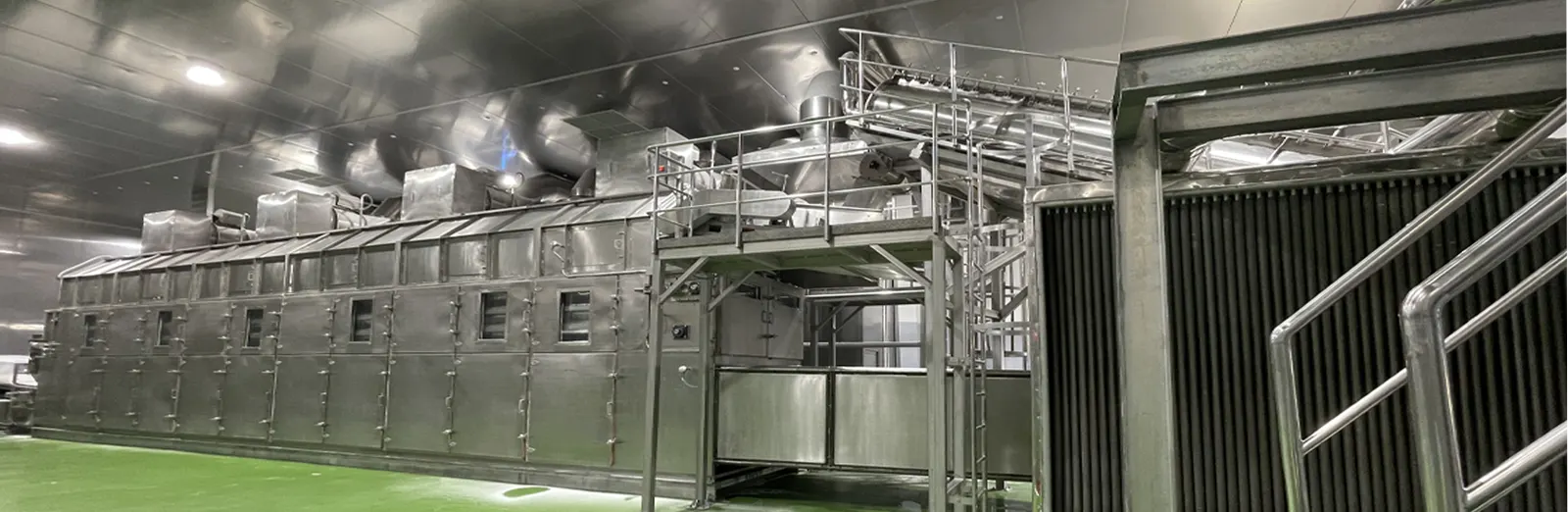
Industrial Belt Dryer RFQ Checklist: Technical Data for an Accurate Quotation
For industrial plants and engineering buyers. A useful belt or band dryer enquiry identifies the material, wet feed rate, moisture reduction, utilities and plant requirements. These inputs allow an application-specific assessment instead of an unreliable generic price.
1. Material and feed characteristics
Identify the product and process: food or feed ingredients, municipal or industrial sludge, biosolids, biomass, agricultural residues or separated digestate. Provide particle size, form, wet bulk density, flow behaviour and any stickiness, dust, odour, corrosion or contamination concerns. A representative sample and analysis are particularly useful for difficult products.
2. Throughput and moisture basis
State the wet feed rate in kg/hour or tonnes/hour and both inlet and target moisture on a clearly identified basis. If the production target is dry product output, say so explicitly. Supply operating hours and expected feed variation. These values underpin the water-removal calculation.
Use the worked evaporation-load guide to distinguish wet feed, dry solids, finished product and water removed.
3. Product quality and temperature limits
Confirm maximum product temperature and whether colour, active components, volatile components, texture or nutrient quality must be protected. State the required final-moisture range and downstream process. Residence time, belt loading, air temperature and zone configuration require engineering evaluation.
4. Available heat, electricity and exhaust requirements
Identify whether steam, hot water, thermal oil, gas, electricity or usable waste heat is available. Include pressure, temperature, flow and operating availability where known. Describe emission restrictions, odour control, dust filtration, corrosion and combustible-dust or hazardous-area requirements. See the waste-heat assessment guide when recovered energy is proposed.
5. Scope, layout and project requirements
Provide available floor area and height, access restrictions, installation country, preferred materials, automation needs, upstream preparation, downstream conveying, utilities, FAT or trial expectations and delivery schedule. State applicable codes and site classification rather than assuming a certification category.
Industrial belt dryer RFQ checklist
- Material name, source, composition and physical characteristics
- Wet-feed throughput and operating hours
- Inlet and outlet moisture, with wet- or dry-basis identified
- Target product quality, form and temperature limit
- Heat source, available utilities and energy constraints
- Plant layout, country, installation and environmental conditions
- Dust, odour, corrosion, hygiene and safety requirements
- Expected project timing, budget stage and decision process
Frequently asked questions
What is the difference between a belt dryer and a band dryer?
Both terms commonly describe continuous equipment conveying a product through controlled drying zones on a belt or band. Actual configurations depend on belt type, airflow and material handling; compare the technical design rather than relying on the name alone.
When are material trials useful?
Trials are valuable for sticky sludge, unusual biomass, variable digestate and temperature-sensitive materials where flow, adhesion, permeability and quality can affect equipment selection.
Compare the band dryer, mesh belt dryer, single-pass and multi-pass configurations. Review the cost and scope checklist, then send GEM the available process data for a preliminary assessment.
