



GEM DRYTECH · INDUSTRIAL BELT DRYING
Assess whether belt drying fits the separated solids from your anaerobic digestion process. Gem Drytech Systems LLP offers industrial drying equipment and pilot trials to support material evaluation and project planning.
Get a dryer selection & budget quotation Explore pilot trials
Start with separated digestate, not total slurry flow
Digestate composition varies with feedstock, digester operation and separation method. A belt-dryer assessment normally starts with the separated solid fraction and its handling behaviour. Provide the wet-solids rate, dry-solids content, consistency, fibre or particle form, bulk density and expected variability.
Liquid digestate generally requires mechanical separation or another preparation step before a belt can carry it. The required press, centrifuge, mixer, back-mixing system, extruder or feeder should be treated as part of the process boundary where applicable.
Define capacity on a clear basis
A statement such as “five tonnes per hour” is incomplete unless it identifies wet feed, dry solids or finished product. Inlet and target moisture must use the same wet- or dry-basis convention.
For water-only drying with conserved dry solids, calculate dry solids first, then finished product and water evaporated. The evaporation load is the starting point for the heat balance, but it does not by itself establish belt area, drying time or utility consumption. Use the worked evaporation-load guide to prepare this basis.
How a digestate belt-drying concept is evaluated
| Question | Why it matters |
|---|---|
| Can the feed be distributed as a stable, permeable bed? | Smearing, sealing or uneven loading can restrict airflow and create non-uniform drying. |
| Does the material remain manageable through the sticky phase? | Adhesion, agglomeration and shrinkage can affect feeding, belt cleaning and discharge. |
| What is the validated drying time? | Residence time should follow representative trials or relevant operating evidence, not a generic value. |
| What heat is actually available? | Temperature, flow, operating schedule and contaminants determine usable duty. |
| What happens to exhaust air? | Humidity, odour, ammonia, dust, corrosion and local emission requirements can control system design. |
| What is the destination of the dried material? | Final moisture, particle form, cooling, storage and regulatory requirements depend on the intended use. |
Assess available heat from the biogas project
Biogas facilities may have engine cooling water, exhaust gas, hot water, steam or another recoverable source. Provide the heat medium, supply and return temperatures, flow or available duty, allowable pressure drop, composition, normal operating hours and minimum/maximum conditions.
A source can contain substantial total energy yet still be unsuitable because its temperature is too low, availability does not match the dryer schedule, or direct contact creates contamination or corrosion concerns. A heat exchanger, backup source, storage or process turndown may need evaluation.
See the industrial waste-heat drying guide. Any expected reduction in purchased energy must be calculated from the actual source and drying duty; it should not be assumed from the presence of waste heat alone.
Feed preparation and belt configuration
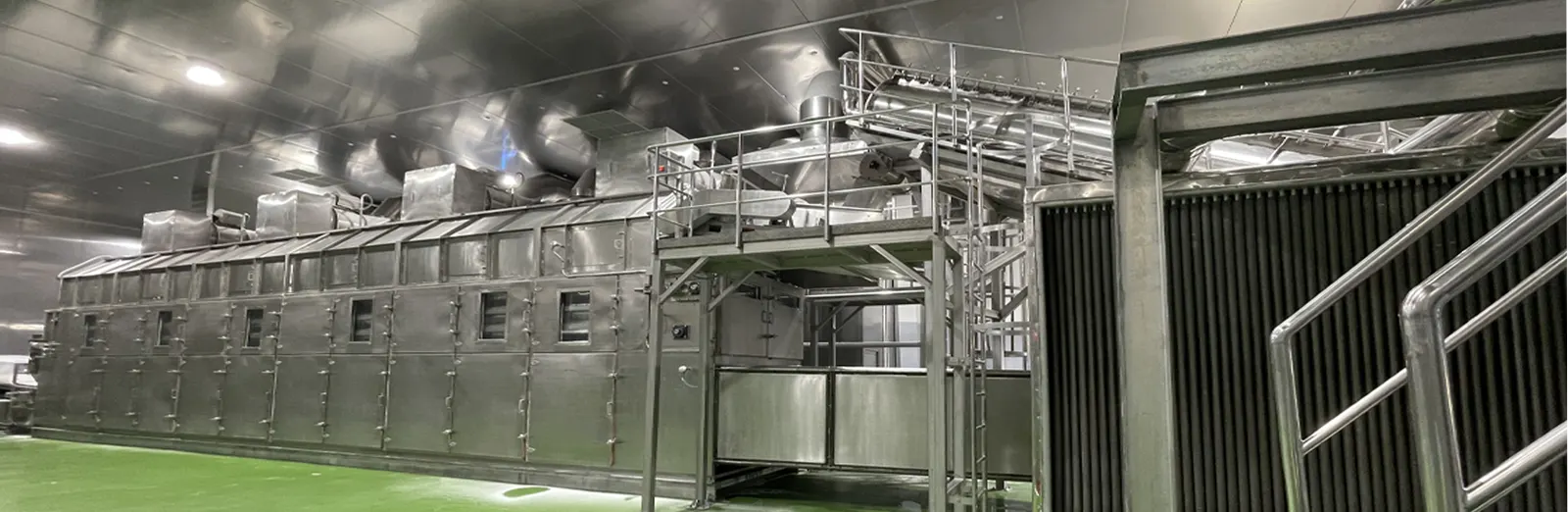
A belt carries a distributed product bed through heated airflow. Belt type, loading, bed depth, airflow direction, zone arrangement and belt speed must match the material. Sticky digestate cake may require extrusion, mixing or back-mixing to improve handling and air passage.
A single-pass arrangement limits belt transfers but may require more length. A multi-pass arrangement can provide longer travel in a smaller footprint, while adding transfer points and height. The selection should consider friability, dust, access, cleaning and site layout.
Plan the complete process, not only the dryer
- Wet digestate reception, storage and controlled feeding
- Mechanical separation and feed conditioning where required
- Dryer, heat source, fans, ducting and controls
- Dust, odour, ammonia and exhaust-air treatment as applicable
- Dried-product cooling, conveying, storage and fire monitoring
- Cleaning access, wash-water management and maintenance space
The intended use of dried digestate and all local product, fertiliser, waste, emission and safety requirements remain the project owner’s responsibility. Drying alone does not establish that the output is a compliant fertiliser, fuel or saleable product.
Safety and material data cannot be assumed
Supply available information on dust combustibility, self-heating, ammonia or other gases, corrosion, contaminants and biological or hygiene risks. Required controls depend on the material and jurisdiction. Unknown hazard data can block final equipment selection and any performance guarantee.
Pilot evaluation before final sizing
A representative sample and process data help assess spreading, permeability, sticking, shrinkage, odour, dust and moisture uniformity. Trial conditions should record material preparation, bed depth, temperature, humidity, air velocity, time and moisture-test method. Scale-up still requires heat and mass balances, airflow and pressure-drop calculations and mechanical design.
Information needed for a preliminary proposal
- Digester feedstock and digestate composition or available analysis
- Separation equipment and wet-solids rate under normal and maximum conditions
- Inlet and target moisture with basis and test method
- Feed consistency, size, wet and dry bulk density, stickiness and sample availability
- Available heat-source data and electrical supply
- Operating hours, ambient/site conditions and installation country
- Odour, emissions, safety and dried-product requirements
- Required equipment scope and project schedule
Use the belt dryer RFQ checklist and the equipment-scope and operating-cost guide. Preliminary sizing and pricing remain subject to confirmed process, product, utility, safety, site and scope data; performance guarantees require validated drying data or trials and GEM engineering approval.
Your material. Your process.
These are selection considerations, not a universal performance claim. See the mesh belt dryer, band dryer and full dryer range, or discuss your requirement with us.
Frequently asked questions
Can liquid digestate go directly onto a belt dryer?
Normally, the proposal begins with a separated or otherwise prepared solid fraction that the belt can retain and carry. Share the separation process, solids content and handling behaviour so pretreatment can be assessed.
Can heat from a biogas engine be used?
Potential use depends on the heat medium, temperature, flow, composition, availability and required drying duty. Direct and indirect recovery have different contamination, corrosion and control implications.
Does lower drying temperature always mean lower operating cost?
No. Lower-temperature heat may be inexpensive or recoverable, but it can require more air, area or residence time. Compare the complete system and available heat rather than air temperature alone.
What information is needed to start?
Send the feedstock source, separation method, wet solids throughput, inlet and target moisture, available heat details, operating hours, installation country, intended use and a representative sample if available.
Get a dryer selection & budget quotation
Tell us what you need to dry, your required capacity and installation country. Share inlet and target moisture, available heat and project timing if known. Estimates are welcome; write “not sure” where you need guidance. Our team can review suitable dryer options and the information needed for a budget quotation. Final selection and pricing depend on your material and project requirements.
Prefer to discuss first? WhatsApp +91 98311 73874 or contact Gem Drytech.
