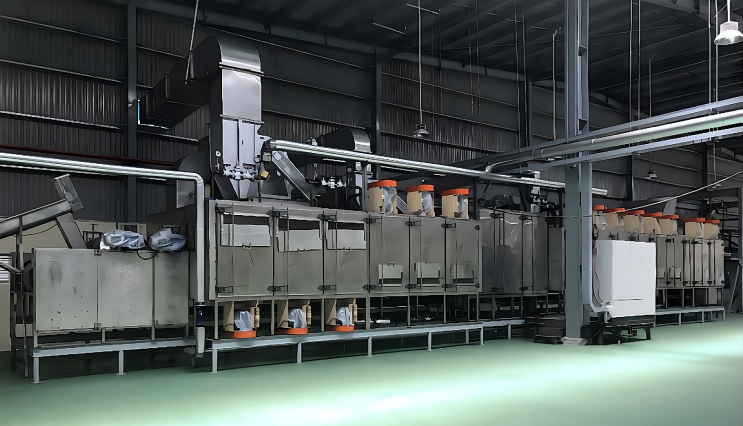
Ashwagandha root drying stabilises the roots of Withania somnifera for powders and standardised extracts. Value depends on withanolide content and on supplying root only, without aerial parts, which regulators and buyers now check. The roots are fibrous and vary in thickness, so cutting and residence time determine how evenly they dry.
To dry ashwagandha root, GEM recommends the Multi-Pass Conveyor Dryer. Typical moisture is 65–75% in the feed and 8–10% after drying. Band Dryer and Single-Pass Conveyor Dryer are used when the feed or site calls for it. Every project starts with a pilot trial on your own sample.
A multi-pass conveyor dryer gives the long residence fibrous roots need and turns pieces between passes, evening out moisture across mixed thicknesses. A Beltotherm band dryer suits larger volumes; single-pass dryers suit small, uniform root cuttings.
| Typical feed moisture | 65–75% |
| Typical target moisture | 8–10% |
| Recommended dryer | Multi-Pass Conveyor Dryer |
| Alternatives | Band Dryer, Single-Pass Conveyor Dryer |
| Application area | Herbal, Botanical & Nutraceutical |
| Industries | Nutraceuticals & Herbal, Pharmaceuticals & Biotech |
Clean, evenly dried root with verified withanolide content commands higher prices from supplement makers, especially in export markets where root-only and contamination specifications are enforced.
Plants searching for a ashwagandha root dryer or comparing a ashwagandha drying machine usually need three answers: which dryer fits, what it costs to run, and how fast it pays back. For Ashwagandha Root, we start from your throughput, current moisture (typically 65–75%) and the target (8–10%), trial a sample on the Multi-Pass Conveyor Dryer, and return a sized recommendation with a budget quotation for your nutraceuticals and pharmaceuticals operation.
We trial your material in our pilot facility before any equipment decision, then size the dryer from real data.
Describe it in the form, or message an engineer directly.