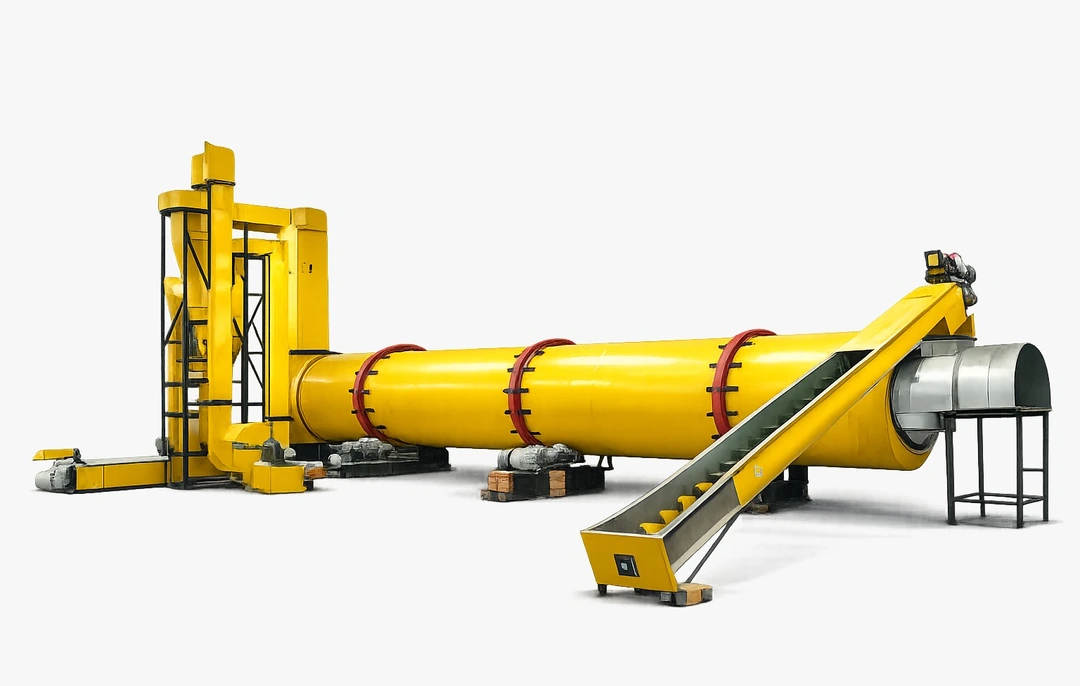
Calcium Carbonate

Calcium Carbonate Drying

Calcium carbonate drying applies mainly to precipitated (PCC) and wet-ground (GCC) filter cakes, where an ultrafine particle size has already been engineered upstream. The dryer's job is to take out a large share of water without letting those particles fuse into hard agglomerates that ruin performance in paper, plastics and paint.

Quick answer

To dry calcium carbonate, GEM recommends the Flash Dryer. Typical moisture is 35–50% in the feed and 0.2–0.5% after drying. Rotary Dryer and Direct / Indirect Rotary Dryer are used when the feed or site calls for it. Every project starts with a pilot trial on your own sample.

1998established112+installations7countriesDried & Testedin-house pilot trialsCertifications · Case studies
The challenge

What makes Calcium Carbonate hard to dry

  • PCC filter cake holds a high water content and behaves like a thick paste that clogs conventional feeders.
  • Hard agglomerates formed during drying are difficult to break and reduce dispersion in polymer compounds and coatings.
  • Whiteness and brightness must be preserved, so combustion residues and iron contamination are not acceptable.
  • Ultrafine product needs high-efficiency collection, because losses through the stack are lost revenue.
How GEM dries it

The right dryer for Calcium Carbonate

A flash dryer with a cage mill or disintegrator breaks wet cake into fine particles and dries them in seconds, limiting agglomeration. Rotary dryers suit coarser GCC grades at large tonnage, and an indirect rotary is used where flue gas must not touch the product.

Typical feed moisture35–50%
Typical target moisture0.2–0.5%
Recommended dryerFlash Dryer
AlternativesRotary Dryer, Direct / Indirect Rotary Dryer
Application areaMinerals, Ores & Ceramics
IndustriesMinerals, Mining & Ceramics, Paper & Pulp, Polymers, Rubber & Resins
The value

What drying Calcium Carbonate unlocks

Dry, dispersible carbonate sells into plastics and masterbatch, where moisture below about 0.5% is often a condition of purchase. Drying also converts a heavy slurry or cake into a product that ships economically in bulk bags.

Dried Calcium Carbonate becomes

  • Polymer and PVC filler
  • Paper filler and coating pigment
  • Paint and sealant extender
  • Food and pharma calcium grades
For buyers

Buying a Calcium Carbonate dryer?

Plants searching for a calcium carbonate dryer or comparing a PCC drying usually need three answers: which dryer fits, what it costs to run, and how fast it pays back. For Calcium Carbonate, we start from your throughput, current moisture (typically 35–50%) and the target (0.2–0.5%), trial a sample on the Flash Dryer, and return a sized recommendation with a budget quotation for your minerals and paper operation.

FAQ

Calcium Carbonate: questions buyers ask

What moisture do plastics customers expect for calcium carbonate?
Filler grades for polymers are usually specified at or below about 0.2–0.5% moisture, because water causes voids and processing problems. Coated grades may need even tighter limits, which affects dryer and cooler sizing.
Can PCC cake be dried without a spray dryer?
Yes. A flash dryer with a back-mixing feeder and disintegrator is commonly used for PCC filter cake. A pilot trial confirms whether your cake needs back-mixing and what particle size the dried powder reaches.
Related

Related materials

Compare all 23 materials in Minerals, Ores & Ceramics.

Send us a sample. See it dried.

We trial your material in our pilot facility before any equipment decision, then size the dryer from real data.

  1. Tell us the material, moisture and throughput.
  2. An engineer confirms the trial plan and sample shipping.
  3. You get drying data and a sized recommendation with a budget quotation.

Material not listed? Talk to our technical expert.

Describe it in the form, or message an engineer directly.

Request a trial or quotation

    An engineer replies within one working day. We never share your details.

    whatsapp