How to Dry Onion and Garlic Flakes at Industrial Scale: Moisture, Colour and Aroma
Posted On: November 16, 2026
A batch of dried onion flakes can meet its moisture specification and still disappoint the buyer. Uneven colour, weak aroma, excessive fines, or poor rehydration can reduce its value. Garlic processors face similar challenges, especially when fresh material varies between suppliers and seasons.
Successful industrial onion and garlic drying brings preparation, airflow, temperature, residence time and packaging together. Every stage affects what reaches the customer.
For processors supplying seasonings, ready meals, soups and export markets, the objective is consistent flakes that meet an agreed product specification. Here is how to plan the process.
Begin with the Finished Product Specification
Before selecting equipment, define what your buyer expects. Onion flakes for soup mixes may have different requirements from garlic flakes intended for grinding.
Agree on final moisture, water activity, flake size, colour, flavour, rehydration performance and microbiological criteria. Record the test methods too, so your production team and customer assess quality consistently.
Moisture content measures how much water remains. Water activity describes how available that water is for microbial growth and other changes. Both help assess product stability.
Set the final moisture target around the product, buyer requirements and packaging system. Confirm it through testing before fixing the dryer settings.
Prepare the Feed for Consistent Drying
Select and clean the raw material
Start with sound bulbs and remove damaged or deteriorated material. Differences in variety, maturity and dry matter influence yield and drying behaviour.
Peel, trim and wash according to your established food processing procedure. Remove excess surface water before feeding the dryer. Water carried over from washing increases the evaporation load without increasing saleable output.
Keep the time between preparation and drying controlled, particularly when ambient conditions are warm.
Maintain uniform slice thickness
Thickness strongly influences drying time. Thin pieces can become brittle while thicker pieces remain wet inside.
Set and check the slicer regularly. Look for a consistent thickness distribution across the feed, including after blade changes or adjustments.
Assess pretreatments against the intended flavour and appearance. Research on onion and garlic slices shows that pretreatment choices can affect moisture, water activity, and browning, making product trials valuable before adopting a procedure.
How a Continuous Band Dryer Fits the Process
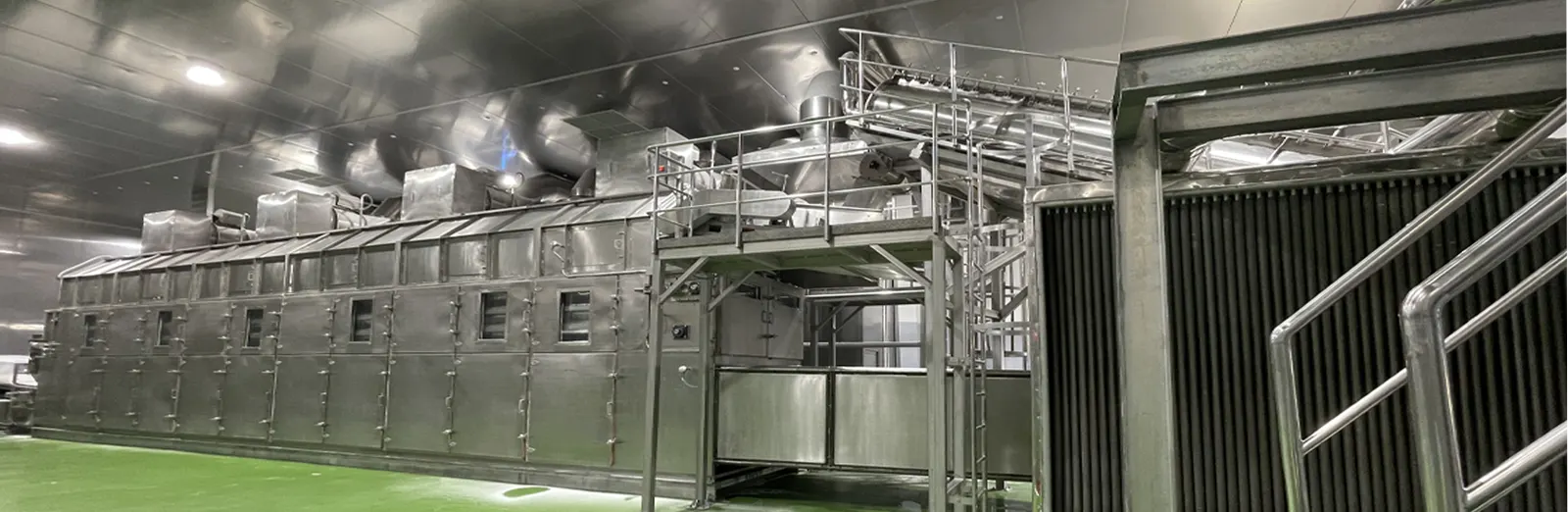
A continuous band dryer carries prepared flakes through a drying chamber at a controlled speed. Heated air passes through or across the product bed, carrying away evaporated moisture.
Operators adjust the process using temperature, airflow, exhaust, and conveyor speed. Consistent feeding helps maintain a stable layer across the working width.
The Beltotherm® band dryer from Gem Drytech Systems LLP uses multiple drying zones and controlled conveyor movement. Its configuration and heating arrangement are selected around the application, feed capacity, inlet moisture and required output.
Continuous drying also needs dependable upstream preparation. An irregular supply from peeling or slicing can create variations in bed depth and discharge moisture.
Control Moisture Across the Entire Product Bed
An average moisture result can conceal wet pockets. Take samples across the discharge width and at different operating times.
Three settings deserve particular attention.
- Bed depth affects how easily air reaches the flakes.
- Air distribution affects drying consistency across the conveyor.
- Residence time determines how long the material stays inside.
Increasing bed depth to raise production can restrict airflow and leave wetter material within the layer. Check the spreader and feed rate before changing temperature.
For an illustrative sizing calculation, consider 1,000 kg/h of prepared feed at 85% moisture, dried to 5% moisture, both on a wet basis. Assuming dry solids are conserved, the output would be about 158 kg/h, with about 842 kg/h of water evaporated.
This example demonstrates why dryer sizing needs both moisture values alongside feed capacity.
Protect Colour Through the Drying Cycle
Browning is often most noticeable when the product approaches its final moisture. As evaporation slows, its cooling effect decreases, and the product temperature can rise.
An onion drying study observed more severe browning towards the end of drying under its experimental conditions. This supports checking the finishing stage carefully when colour deteriorates.
Use the available drying zones to establish a suitable profile through trials. Check actual product condition alongside air temperature.
Compare samples under consistent lighting, using an agreed reference or instrumental colour measurement. Record the result with feed variety, slice thickness and operating settings.
When colour changes suddenly, investigate preparation delays, airflow, feed distribution and residence time together.
Preserve the Aroma Your Customer Expects
Onion and garlic flavour depends on their composition and processing history. Slicing, pretreatment, drying and storage all contribute to the final sensory result.
Garlic research has found differences in flavour characteristics between drying methods, highlighting the importance of evaluating aroma alongside moisture.
Assess dried samples using a repeatable sensory procedure. If the flakes will enter soups or sauces, compare their flavour after rehydration or cooking under standard conditions.
Keep onion and garlic settings separately documented. Each product deserves its own validated operating recipe.
For plants processing multiple ingredients, include cleaning and changeover checks to manage flavour carryover.
Cool and Pack Before Moisture Returns
Cooling and packaging complete the drying process.
Hot flakes entering packs can create condensation if conditions allow moisture to collect. Exposure to humid room air can also increase moisture after drying.
Establish a suitable packing temperature and minimise unnecessary holding time. Select packaging around the required barrier properties, storage conditions and shelf life.
Check final packed samples for moisture, water activity, colour and aroma.
For export projects, agree on destination and customer requirements during process planning. Our article on
food-grade dryers for Indian exporters provides further context for equipment discussions.
Troubleshoot Quality Changes Systematically
| Observation | Checks to prioritise |
|---|
| Wet flakes among dry pieces | Slice thickness, overlapping feed, bed depth and airflow distribution |
| Darkened edges | Finishing conditions, residence time and uneven slice size |
| Weak aroma | Pretreatment, temperature exposure, holding time and packaging |
| Excessive fines | Overdrying, transfer drops and downstream handling |
| Moisture rising after packing | Cooling conditions, room humidity, seals and packaging barrier |
Change one setting at a time where practical and record the result. This makes successful adjustments easier to repeat.
Frequently Asked Questions
1. Which dryer suits industrial onion and garlic flakes?
A continuous band dryer is a practical option to evaluate for sliced products requiring controlled airflow and residence time. Confirm its suitability using representative material and your finished product specification.
2. What drying temperature should we use?
Establish the temperature profile through trials. Slice thickness, bed depth, airflow, feed condition, and quality targets all affect the result. Record each zone setting and verify discharge moisture, colour, and aroma together.
3. Can one line process both onion and garlic?
A line may accommodate both products when its operating range and construction suit each duty. Evaluate separate recipes, cleaning access, changeover time, and flavour carryover before confirming the arrangement.
4. How can we improve output?
First, identify the limiting stage. Slicing, feeding, airflow, heating capacity, or packing may restrict production. Compare saleable dried output and energy consumption while maintaining the agreed quality specification.
Validate Your Product with Gem Drytech Systems LLP
Planning a new dehydration line or improving an existing process? Share your prepared feed capacity, inlet moisture, target moisture, slice dimensions, and available utilities with
Gem Drytech Systems LLP.
A representative trial helps assess drying behaviour and compare the resulting flakes against your quality requirements.