


Direct vs Indirect Rotary Dryers: Which One Suits Your Material?
Posted On: November 12, 2026
Two plants can process the same tonnes per hour and need very different dryers. A biomass plant may be able to dry screened wood chips in a stream of hot gas. A specialty chemical plant may need to keep combustion gases away from its product and control how vapour leaves the system. Both can use a rotary dryer, but the way heat reaches the material changes the design, operating cost, and equipment needed around the drum.
When comparing a direct vs indirect rotary dryer, start with one question. Can your material come into contact with the proposed drying gas? Once you know the answer, compare how the feed behaves, what moisture and quality you need at discharge, and which utilities your plant can supply.
How does a direct rotary dryer work?
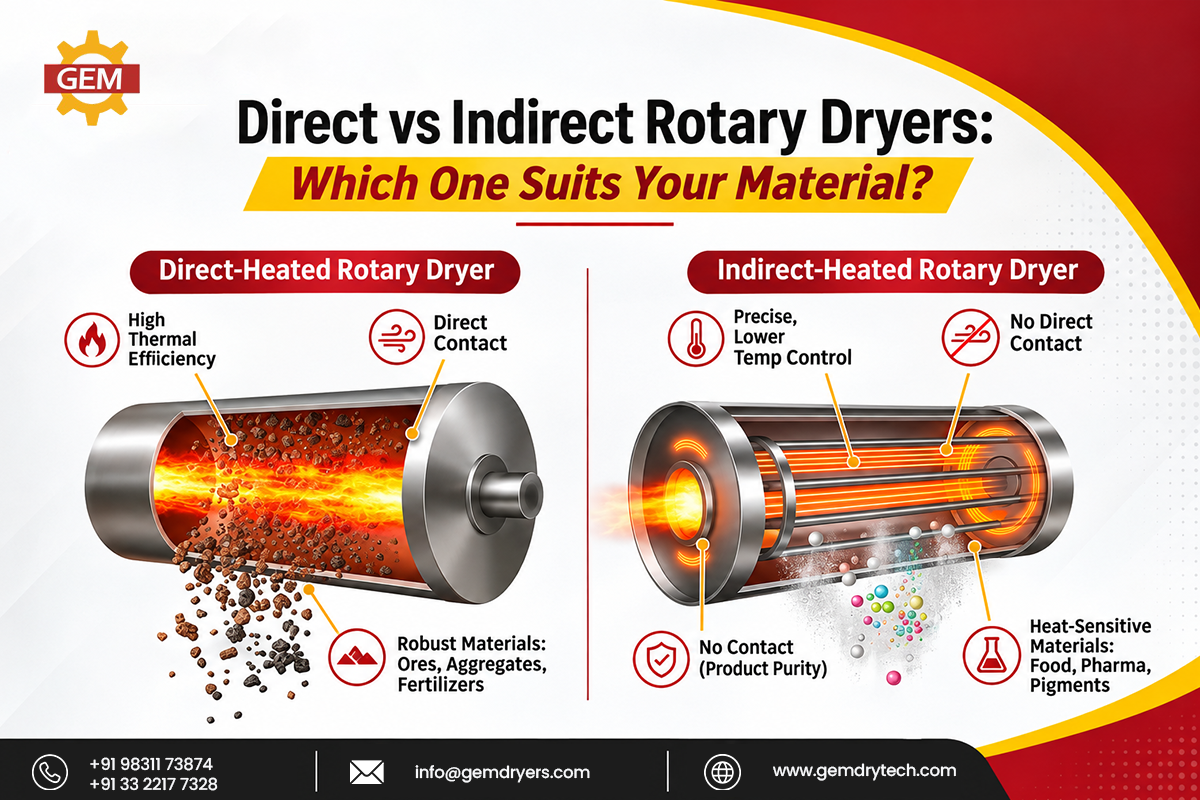
In a direct rotary dryer, hot air or another suitable drying gas passes through the rotating drum and contacts the wet material. Internal lifting flights pick up the solids and drop them through the gas stream. As the solids tumble, moisture evaporates and leaves with the exhaust gas. The dried material discharges at the other end of the drum.
Direct drying is worth evaluating for materials such as screened wood chips, sand and certain mineral products. These feeds can often be lifted and dispersed inside the drum, giving the drying gas good access to the wet solids. Fine, dusty, or sticky feeds need closer assessment. Fine particles can travel out with the exhaust, while sticky feed can build up on the flights and change how the material moves through the dryer. Depending on the feed and exhaust requirements, the system may need a cyclone, bag filter, or other treatment equipment.
For more on how the rotating drum handles bulk solids, read our guide to the advantages of using a rotary dryer machine.
How does an indirect rotary dryer work?
An indirect rotary dryer transfers heat through a metal surface. In a steam tube bundle design, for example, steam flows inside tubes while the wet solids tumble around their outer surfaces. Heat passes through the tube walls into the solids. The evaporated moisture leaves through a separate vapour outlet, where it can be handled according to the process requirements.
An indirect design is worth evaluating when product quality calls for separation from the heating medium or when the plant needs more control over vapour handling. The material still needs to move across the heated surfaces effectively. If it coats the tubes or forms lumps, heat transfer and product consistency can suffer. A trial can show whether the feed stays mobile as it dries or whether another dryer type deserves a closer look. See how the two configurations are built on our direct and indirect rotary dryer product page.
Direct vs indirect rotary dryer comparison
| Selection factor | Direct rotary dryer | Indirect rotary dryer |
|---|---|---|
| Heat transfer | Hot drying gas contacts the solids inside the drum. | Heat passes through a surface such as a steam tube. |
| Product contact | The product contacts the drying gas. Gas quality matters. | The heating medium stays separate from the product. |
| Typical candidates | Free-flowing bulk materials such as sand, screened wood chips and some mineral products. | Materials that can tumble across heated surfaces and need separation from the heating medium. |
| Exhaust and vapour | The exhaust carries evaporated moisture and may carry fine particles. | Vapour leaves separately. The design may use sweep gas or vapour treatment, depending on the duty. |
| What to check in a trial | Particle carryover, moisture uniformity, and how well the flights lift the feed. | Surface build-up, heat transfer and how consistently the material discharges. |
How to choose the right rotary dryer for your material
1. Start with product quality and gas contact
Ask what would make the dried material unacceptable to your customer. For a mineral feed, the main concern might be whether it meets the final moisture specification. For a specialty ingredient, colour, aroma, or purity may also matter. A direct rotary dryer can use clean heated air when the application permits it. If your product specification calls for separation from the heating medium, assess an indirect design and confirm the product quality in a trial.
2. Calculate the water you need to remove
Wet feed rate alone can be misleading. Suppose your plant feeds 2,000 kg/h at 50% moisture and needs a dried product at 10% moisture, both on a wet basis. The feed contains 1,000 kg/h of dry solids. Assuming those solids are retained, the dried output is about 1,111 kg/h, so the dryer must evaporate about 889 kg/h of water.
Use the evaporation load to compare quotations on the same basis. Share the normal and maximum inlet moisture as well. A feed that becomes wetter during the monsoon can increase the evaporation load even when the feeder runs at the same rate.
3. Check how the feed changes as it dries
A sample can look manageable at the feed chute and behave differently halfway through the dryer. Some materials pass through a sticky phase and form lumps. Others become brittle and generate fines as moisture falls. During a trial, check the dried product’s particle size and texture alongside final moisture. If the next step is screening, conveying, or pelletising, the discharge condition matters as much as the number on the moisture report.
4. Compare the cost of running the full system
Check the cost and availability of steam, fuel, electricity, or recovered heat at your site. Then compare the full equipment scope, including fans, drives, dust collection, vapour treatment and cleaning access. Ask suppliers to quote energy consumption for the same feed rate, inlet moisture, and final moisture. Once you have agreed on the process duty, use our guide on how to choose the right rotary dryer manufacturer for your industry to compare proposals and supplier capabilities.
Test your material before you specify the dryer
If you are deciding between direct and indirect rotary drying, share your material and operating targets with Gem Drytech Systems. Our team can review your evaporation load, discuss the utilities available at your plant, and identify what a trial should measure before you finalise the equipment specification.
Contact us to discuss your project or request a pilot drying trial with your own material.
Frequently asked questions
1. Which rotary dryer is more energy-efficient?
The answer depends on the moisture load, available utilities, and system design. For a practical comparison, ask each supplier for thermal energy per kilogram of water evaporated and electrical demand for the complete system at the same operating point. Include the cost of generating steam or hot air when comparing operating costs.
2. Does a direct rotary dryer always expose the product to flue gas?
A direct dryer exposes the product to the drying gas. That gas can be clean air heated through a heat exchanger or a suitable combustion gas stream, depending on the design. This distinction matters when your specification allows contact with hot air and places restrictions on combustion products.
3. Is an indirect rotary dryer suitable for sticky material?
Suitability depends on how the feed behaves throughout the drying cycle. A sticky material can coat heated surfaces and reduce heat transfer. A representative sample trial can reveal build-up, lump formation, and discharge problems. If the feed continues to foul the surfaces, a paddle dryer may be worth evaluating.
4. What information should I send before requesting a quotation?
Share the material name, wet feed rate, inlet moisture range, target outlet moisture, particle size, operating hours, and available heat sources. Include any limits on product temperature, colour change, or contact with combustion gases. If possible, provide a representative sample and explain how the dried material will be used.
