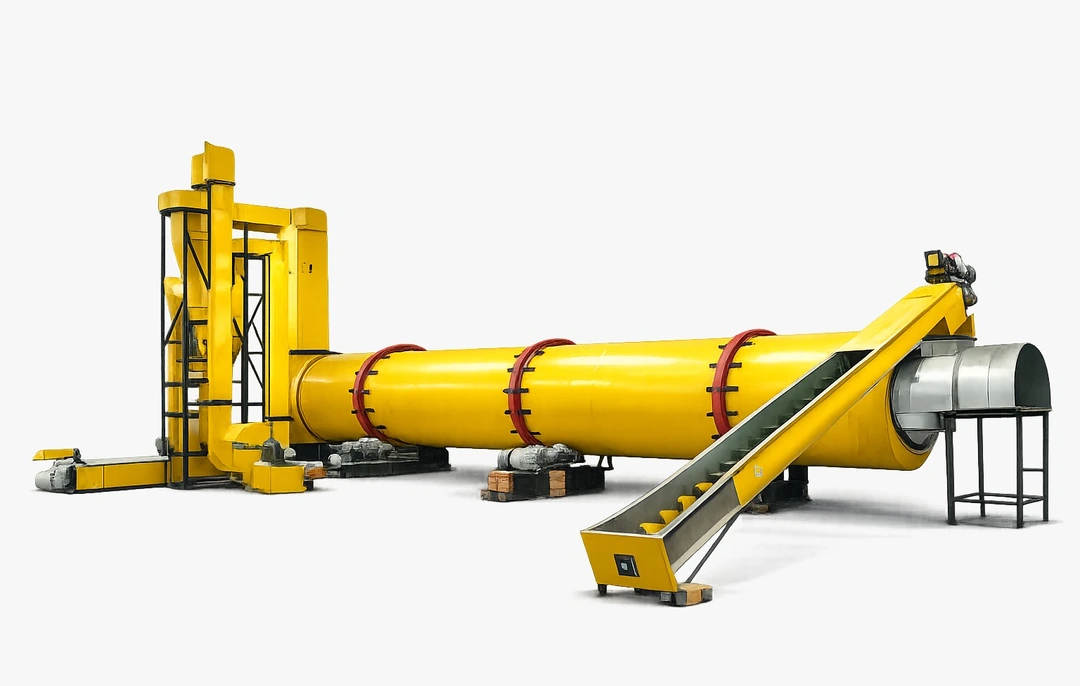
Ammonium sulphate drying takes crystals from the centrifuge, often by-product from caprolactam, coke-oven or acid scrubbing plants, down to a free moisture of a few tenths of a percent. Little water is removed, but final moisture and temperature decide whether the product flows freely in bags or sets into hard lumps in storage.
To dry ammonium sulphate, GEM recommends the Vibratory Fluid Bed Dryer and Rotary Dryer. Typical moisture is 1–3% in the feed and 0.1–0.3% after drying. Rotary Louvre Dryer and Industrial Cooler are used when the feed or site calls for it. Every project starts with a pilot trial on your own sample.
A vibratory fluid bed dries and cools crystals in one compact unit and suits uniform crystal sizes. A rotary dryer handles larger capacities and wider size ranges, and a separate cooler or louvre dryer is chosen where anti-caking needs longer cooling.
| Typical feed moisture | 1–3% |
| Typical target moisture | 0.1–0.3% |
| Recommended dryer | Vibratory Fluid Bed Dryer, Rotary Dryer |
| Alternatives | Rotary Louvre Dryer, Industrial Cooler |
| Application area | Fertilizers & Agrochemicals |
| Industries | Fertilizers & Agrochemicals, Chemicals & Specialty Chemicals |
Dry, free-flowing ammonium sulphate sells at fertilizer grade instead of being discounted or reprocessed. For chemical plants, drying turns a by-product stream into revenue rather than a disposal cost.
Plants searching for a ammonium sulphate dryer or comparing a ammonium sulphate drying usually need three answers: which dryer fits, what it costs to run, and how fast it pays back. For Ammonium Sulphate, we start from your throughput, current moisture (typically 1–3%) and the target (0.1–0.3%), trial a sample on the Vibratory Fluid Bed Dryer, and return a sized recommendation with a budget quotation for your fertilizers and chemicals operation.
We trial your material in our pilot facility before any equipment decision, then size the dryer from real data.
Describe it in the form, or message an engineer directly.