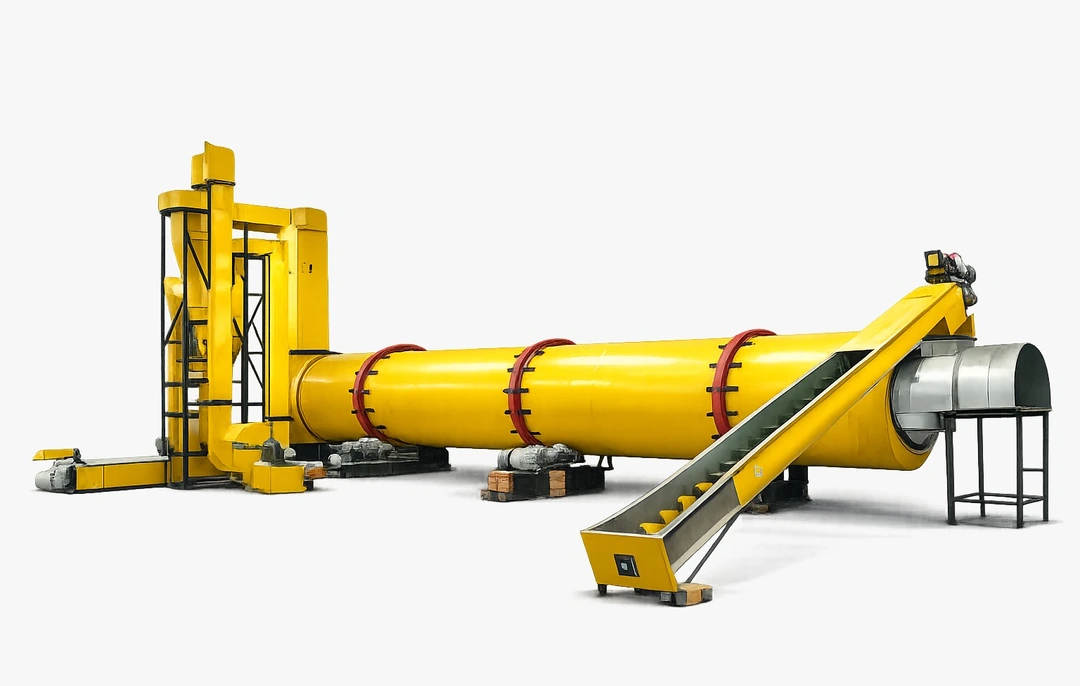
NPK compound fertilizer drying follows granulation, where nutrients are bound into granules containing 3–8% moisture. Drying to 1–2% gives hard granules that store and spread well, but grades containing ammonium nitrate or urea soften, melt or decompose if overheated, so the drying temperature profile is set grade by grade.
To dry NPK compound fertilizer, GEM recommends the Rotary Dryer. Typical moisture is 3–8% in the feed and 1–2% after drying. Rotary Louvre Dryer, Industrial Cooler and Combination Fluid Bed Dryer are used when the feed or site calls for it. Every project starts with a pilot trial on your own sample.
A rotary dryer tumbles granules through hot air with high capacity and tolerance for varying recycle. A rotary louvre dryer is chosen for heat-sensitive grades needing gentler contact, and a fluid bed cooler or rotary cooler conditions granules before coating and storage.
| Typical feed moisture | 3–8% |
| Typical target moisture | 1–2% |
| Recommended dryer | Rotary Dryer |
| Alternatives | Rotary Louvre Dryer, Industrial Cooler, Combination Fluid Bed Dryer |
| Application area | Fertilizers & Agrochemicals |
| Industries | Fertilizers & Agrochemicals |
Hard, dry, uniformly sized granules reduce caking complaints and bag losses and allow a plant to produce a wider range of grades safely. Efficient drying also lowers fuel cost per tonne.
Plants searching for a npk fertilizer dryer or comparing a complex fertilizer dryer usually need three answers: which dryer fits, what it costs to run, and how fast it pays back. For NPK Compound Fertilizer, we start from your throughput, current moisture (typically 3–8%) and the target (1–2%), trial a sample on the Rotary Dryer, and return a sized recommendation with a budget quotation for your fertilizers operation.
We trial your material in our pilot facility before any equipment decision, then size the dryer from real data.
Describe it in the form, or message an engineer directly.