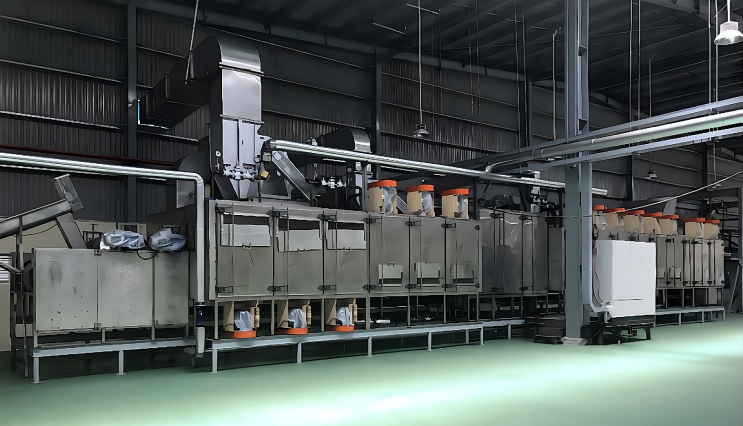
Poultry feed drying and cooling handles pellets and crumbles that leave the pellet mill hot and moist from steam conditioning. Broiler starter crumbles, grower pellets and layer feed all need that added steam moisture taken back out so the feed flows, stores and stays free from mould and Salmonella recontamination.
To dry poultry feed, GEM recommends the Industrial Cooler and Band Dryer (Beltotherm). Typical moisture is 15–17% in the feed and 11–12.5% after drying. Multi-Pass Conveyor Dryer is used when the feed or site calls for it. Every project starts with a pilot trial on your own sample.
A counterflow cooler removes heat and some conditioning moisture with ambient air, which suits most standard mash-pellet lines. A band dryer is added where hydrothermal processing or high-moisture conditioning leaves more water than a cooler alone can remove.
| Typical feed moisture | 15–17% |
| Typical target moisture | 11–12.5% |
| Recommended dryer | Industrial Cooler, Band Dryer (Beltotherm) |
| Alternatives | Multi-Pass Conveyor Dryer |
| Application area | Animal, Aqua & Pet Feed |
| Industries | Animal Feed, Breweries & Distilleries, Agriculture & Grain Processing |
Reliable cooling and drying protects pellet durability, cuts fines returned to the pellet mill and prevents mould losses in bulk bins. Mills also avoid selling water as feed above the moisture limits in customer contracts.
Plants searching for a poultry feed dryer or comparing a poultry feed pellet cooler usually need three answers: which dryer fits, what it costs to run, and how fast it pays back. For Poultry Feed, we start from your throughput, current moisture (typically 15–17%) and the target (11–12.5%), trial a sample on the Industrial Cooler, and return a sized recommendation with a budget quotation for your animal feed and agriculture operation.
Compare all 3 materials in Livestock & Poultry Feed or browse the wider Animal, Aqua & Pet Feed family.
We trial your material in our pilot facility before any equipment decision, then size the dryer from real data.
Describe it in the form, or message an engineer directly.