


Navigating Global Compliance: The Strategic Role of Food Grade Dryers for Indian Exporters

A consignment of premium Indian spices arrives at a major European port, only to be turned away due to trace moisture levels that risked fungal development during transit. This scenario unfolds too frequently for ambitious businesses aiming for international footprints. Crossing borders requires meeting uncompromising sanitary standards that standard machinery cannot fulfill. Delivering agricultural wealth to global markets demands a shift from generic dehydration to specialized, compliant processing.
Investing in the right equipment transforms compliance from a hurdle into a competitive advantage. The global industrial food dryer machine market is expanding rapidly, driven by strict safety guidelines like FDA 21 CFR and EU regulations, pushing Indian processors to upgrade their processing lines. At the heart of this operational shift is the strategic implementation of advanced food grade dryers, ensuring that every batch meets the strict moisture, hygiene, and quality benchmarks set by international buyers.

Understanding the Compliance Blueprint for Food Export
International food safety authorities do not just inspect the final product; they evaluate the entire manufacturing ecosystem. Standard industrial drying systems often feature rough surfaces, inaccessible crevices, or components that chip, creating breeding grounds for cross-contamination. True compliance requires machinery engineered with non-reactive surfaces, accessible structures for cleaning, and precise thermal controls that preserve nutritional integrity while eliminating pathogens.
Choosing an industrial dryer for food export business setups requires analyzing how specific materials interact with heat and airflow. Global trading partners look for predictable quality, meaning color, flavor, and texture must remain uniform across shipments. Advanced food grade dryers bridge the gap between high-volume production and strict regulatory adherence, ensuring that businesses avoid costly border rejections and protect their brand reputation.
Deep Dive into Core Industrial Drying Technologies
Spray Drying Systems for Fine Powders
Understanding how spray dryers work in food processing highlights their value for fluid-to-powder transformations. The process begins by atomizing a liquid slurry or concentrate into a fine mist inside a large chamber, where it encounters a controlled stream of hot air. The moisture evaporates instantly, leaving behind uniform, free-flowing powder particles that settle at the base.
This technology provides exceptional micro-encapsulation, making an industrial spray dryer for food processing ideal for protecting delicate flavor compounds or active nutrients from heat degradation. When configuring operations, securing a specialized spray dryer for instant milk powder or fruit pulps guarantees that the final powder reconstitutes perfectly without clumping—a primary metric used by international quality auditors to evaluate premium imports.

Rotary Drying Technology for Bulk Materials
Processors dealing with robust, granular commodities need to evaluate how a rotary dryer works in food industry applications. These systems use a gently inclined, rotating cylindrical drum fitted with internal flights or lifters. As the drum turns, these flights lift the wet material and cascade it through a continuous stream of heated air, ensuring uniform thermal distribution across every particle.
This continuous tumbling action makes a rotary dryer for grain and food commodities highly efficient for handling large volumes without cold spots. Furthermore, adapting the internal flight configuration allows a rotary dryer for biomass and food byproducts to process varying materials safely. From cleaning up agricultural waste to preparing bulk materials, sourcing from a reliable rotary dryer manufacturer India ensures the machine frame handles thermal expansion while maintaining a sterile environment. The flexibility of this design extends even to heavy-sector applications, such as configuring a rotary dryer for animal feed, where moisture uniformity prevents mold growth during long maritime transit.
Tray and Continuous Tray Drying Methods
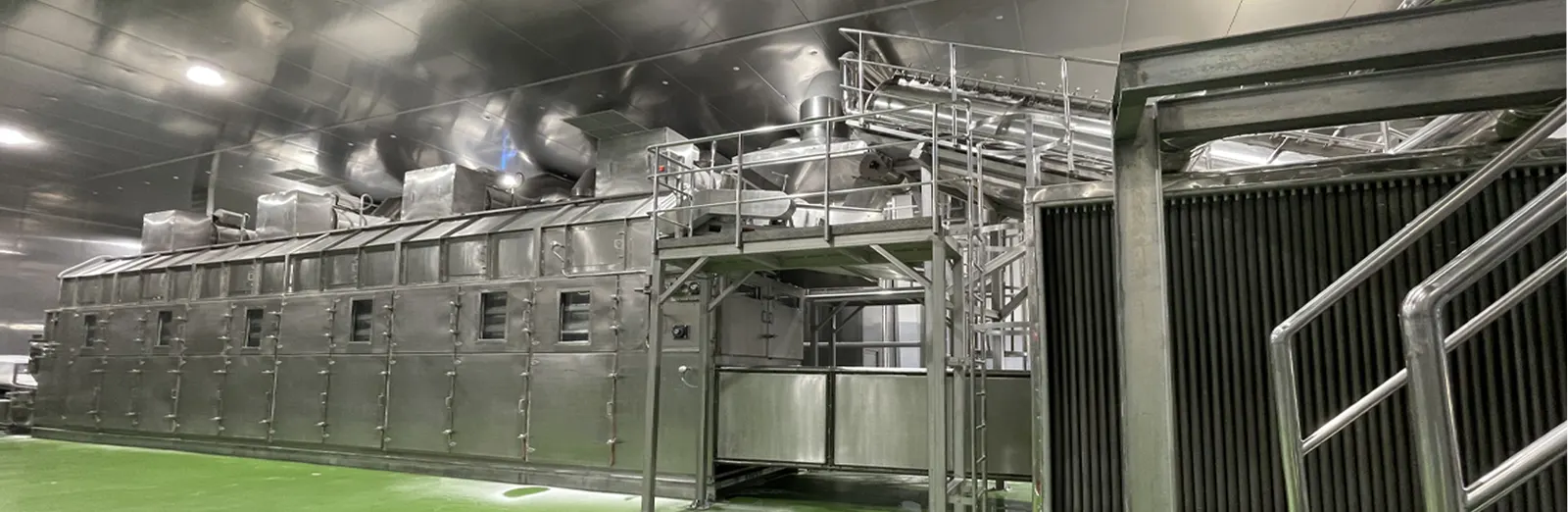
For sliced fruits, vegetables, and specialized botanicals, understanding what is a continuous tray dryer for food plants helps optimize production layouts. Unlike standard batch units, a continuous system moves products on perforated trays or automated mesh belts through sealed, temperature-controlled zones, ensuring uniform moisture removal without manual intervention.
Using a dedicated tray dryer for herbal and spice drying operations protects the volatile essential oils that give spices their market value. For larger operations, relying on a continuous tray dryer for food processing lines ensures steady throughput, reducing structural footprints while preventing the uneven drying common in manual batch turnarounds.

Selecting the Ideal Machine for Your Product Line
Tailoring Technology to Product Characteristics
Every food category responds differently to thermal processing, meaning a one-size-fits-all approach can ruin valuable batches. For instance, processing sticky fruit concentrates or sugary substances requires specialized modifications. Evaluating how rotary dryers handle sticky food products reveals that specialized internal scrapers and polished interior surfaces are necessary to prevent caramelization and clogging along the drum walls.
Analyzing the differences between spray, tray and rotary dryers clarifies that selecting machinery depends heavily on the physical state of your raw ingredient. Liquid concentrates require atomization in a spray system, whereas delicate whole items demand the static placement of a tray system to avoid structural damage, and robust grains need the heavy tumbling action of a rotary drum.
Specializing for High-Value Commodities
Expanding into international markets often requires targeting specific high-demand niches. Deploying a specialized spray dryer machine for food export operations lets you manufacture premium ingredients like encapsulated nutritional powders and clean-label food colorings.
Similarly, running a high-capacity industrial fluid bed dryer for export operations allows for gentle, uniform drying of crystalline or fragile granulated materials by suspending them on a cushion of air. This specialized handling eliminates thermal shock, allowing your products to meet the strict physical and aesthetic criteria demanded by premium global buyers.

Operational Excellence and Future Proofing
Maintaining a competitive edge in global food shipping requires matching strict hygiene protocols with energy efficiency. Modern food grade dryers feature advanced clean-in-place (CIP) automation, allowing operators to sanitize internal chambers thoroughly without time-consuming disassembly. This rapid turnaround minimizes downtime while preventing cross-contamination between different product batches.
Additionally, integrating smart sensors and programmable logic controllers (PLCs) allows facilities to track and record real-time thermal profiles. Providing digital batch logs showing precise temperature and moisture history gives overseas buyers complete transparency. This proactive data collection simplifies third-party food safety audits and builds long-term trust with international distribution networks.
