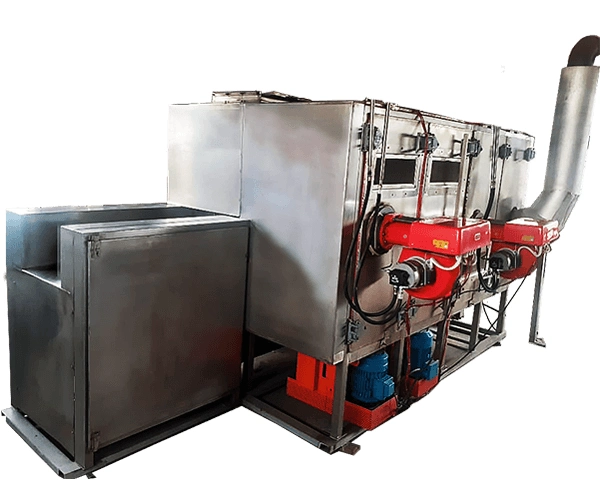
Um torrador industrial é projetado para a torrefação ou secagem uniforme de materiais a granel sob condições controladas. Utilizando sistemas de ar aquecido ou de tambor, garante distribuição uniforme de calor, controle preciso de temperatura e qualidade consistente do produto. Este equipamento é amplamente utilizado nas indústrias alimentícia, química e farmacêutica para a torrefação de nozes, grãos, sementes, pós e outros produtos termicamente tratados.
An industrial roaster is a thermal processing machine designed to heat-treat food grains, nuts, seeds, coffee beans, cocoa, spices, or other materials in order to develop desired flavor, aroma, color, and texture while reducing moisture content. The principle of operation is based on heat transfer through conduction, convection, or radiation, where controlled heating of the product leads to chemical and physical changes such as caramelization, Maillard reactions, and moisture evaporation. These reactions enhance the sensory and nutritional characteristics of the product while ensuring uniform roasting and preventing burning or charring.
The core principle of roasting involves raising the temperature of the product uniformly to a specified level for a defined time period while continuously mixing or agitating it to ensure even heat distribution. Depending on the design, heat can be supplied by hot air (convective roasting), heated surfaces (conductive roasting), or infrared/electric elements (radiative roasting). The temperature range typically varies between 100°C and 300°C, and roasting time depends on product type, size, and moisture content.
Industrial roasters are widely used in the food processing industry for roasting peanuts, cashews, almonds, chickpeas, coffee, cocoa, spices, and grains; and in the chemical and pharmaceutical industries for heat treatment, drying, or stabilization of materials.
The working principle of an industrial roaster is to apply controlled heat to a continuous or batch flow of product to bring about both moisture reduction and flavor development through chemical transformation.
Throughout the process, mechanical agitation or rotation ensures that all particles are uniformly exposed to heat, preventing localized overheating or burning. Simultaneously, moisture-laden air or vapors are continuously removed through an exhaust system to maintain stable temperature and humidity conditions inside the chamber.
The construction of an industrial roaster varies depending on whether it is a batch-type drum roaster, continuous belt roaster, or fluidized-bed roaster, but all share several essential components:
Temperature is precisely controlled using thermocouples and PID controllers, maintaining uniform heat distribution across the chamber.
Garante torrefação ou secagem uniforme em todo o lote.
Permite o processamento preciso de materiais sensíveis ao calor.
Suporta operações contínuas ou em batelada para produção em larga escala.
Sistemas de aquecimento otimizados reduzem os custos operacionais.
Evita danos, rachaduras ou queima de materiais delicados.
Facilita a exposição uniforme ao calor.
Permite que diferentes zonas tenham níveis de calor precisos.
Garante higiene e durabilidade a longo prazo.
Controla a intensidade da torrefação e as características do produto.
Monitora a temperatura, o fluxo de ar e a movimentação de materiais para garantir qualidade consistente.
Para redução imediata da temperatura após a torrefação, mantendo a integridade do produto.



































A Unicoco, Indonésia, estava entusiasmada com o projeto de coco, mas foi através da GEM que realizamos esse sonho. As máquinas da GEM — secadores, transportadores helicoidais, branqueadores, classificadores, etc. — são excelentes e exigem pouca manutenção. Além disso, contamos com suporte 24 horas por dia, 7 dias por semana, caso tenhamos algum problema.
VAMOS EM FRENTE!!!
PT Unicoconut Industries Indonésia, Indonésia
A Franklin Baker Company, das Filipinas, em seu esforço contínuo para ser o padrão ouro em produtos de coco processado, continua a firmar parcerias com os melhores fornecedores OEM para atender às necessidades de suas linhas de produção.
Uma dessas empresas é a GEM Forgings, que tem sido nossa fornecedora confiável de equipamentos de processo para nossos secadores de DC — coco desidratado. Ambas as empresas valorizam a qualidade e o nível de serviço em nossas relações comerciais.
Franklin Baker Company das Filipinas
Entre em contato conosco